
The Code of the Perfect Kitchen: Revealing the Invisible Threads of Minimalism
Project: F+R Apartment
Location: Avivia Residences Bosque Real
Studio: Atlántico Arqs
The perfect kitchen is rarely defined by decoration or by the quantity of design elements present in the space. Instead, its strength lies in a subtle and carefully orchestrated system of relationships that operate almost invisibly. These relationships involve geometry, material continuity, spatial hierarchy, lighting control, and the precise integration of technology within architecture. When these elements work together seamlessly, the result is what could be described as the code of the perfect kitchen.
Minimalism, particularly within contemporary luxury residential design, is not about reducing elements for the sake of simplicity alone. It is about revealing the underlying structure that allows a space to function with clarity, elegance, and calm. Every surface becomes meaningful, every line intentional, and every material transition carefully measured.
In the F+R apartment project at Avivia Residences Bosque Real designed by Atlántico Arqs, the kitchen emerges as a central architectural component within the open living environment. Rather than existing as an isolated functional zone, it becomes a spatial hinge that connects cooking, dining, and social interaction.
One of the fundamental principles of this kitchen is material continuity. A large marble surface extends across the island and climbs vertically across the backsplash, creating a monolithic visual gesture that anchors the space. The marble introduces movement and natural complexity through its veins, allowing the kitchen to remain visually dynamic while maintaining a restrained palette.
Surrounding this stone centerpiece, warm taupe cabinetry creates a calm architectural envelope that integrates appliances, storage, and technical elements. By concealing complexity within the cabinetry, the design preserves a sense of visual tranquility.
Another essential component of the code is layered lighting. Instead of relying on a single dominant light source, the kitchen incorporates ambient ceiling lighting, integrated under-cabinet illumination, and sculptural pendant lights above the island. This layered lighting strategy creates depth, highlights materials, and reinforces the atmosphere of the space.
The pendant lights, composed of soft spherical volumes, introduce a subtle sculptural presence within the kitchen. Their organic geometry contrasts gently with the strict orthogonal lines of the cabinetry and countertops, softening the overall composition.
Equally important is spatial choreography. The island is positioned as both a work surface and a social interface. It allows cooking activities to remain connected with the surrounding living areas while maintaining functional efficiency. Circulation flows naturally around the island, ensuring that the kitchen remains both practical and visually integrated within the apartment.
What ultimately defines the success of this space is not any single design decision but the precise coordination of all these elements. The perfect kitchen is therefore not the result of decoration but of architectural intelligence—a hidden system of proportions, alignments, materials, and light that quietly shapes the experience of the space.
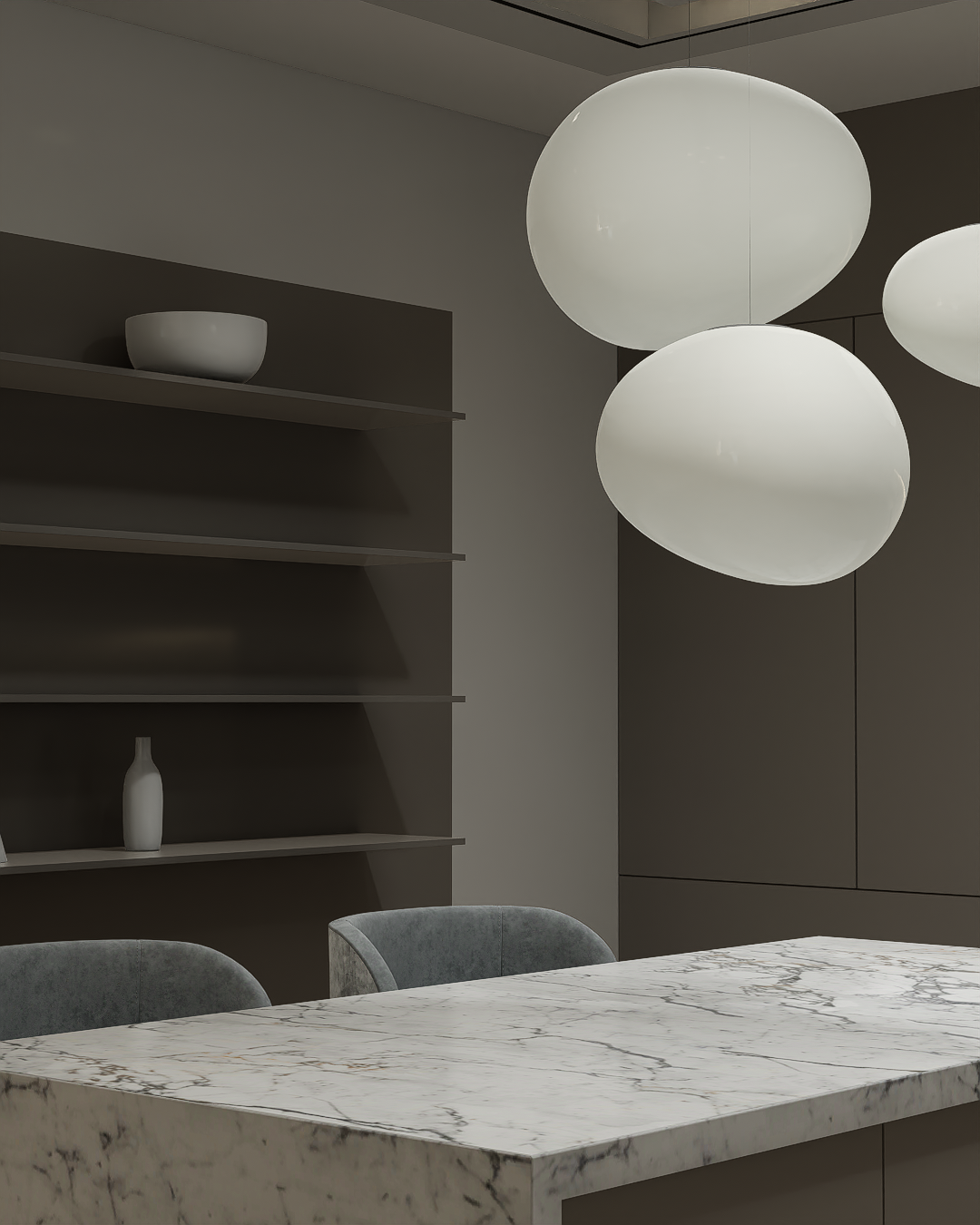
The first image introduces the kitchen through a close relationship between the dining table and the marble island. The polished marble surface extends across both elements, establishing a visual continuity that unifies the dining and cooking areas into a single spatial composition.
Above the table, spherical pendant lights appear as floating objects within the space. Their soft forms introduce a sense of visual balance against the rectilinear architecture of the cabinetry and walls. This moment highlights one of the key strategies of the design: pairing strict geometry with gentle sculptural elements.
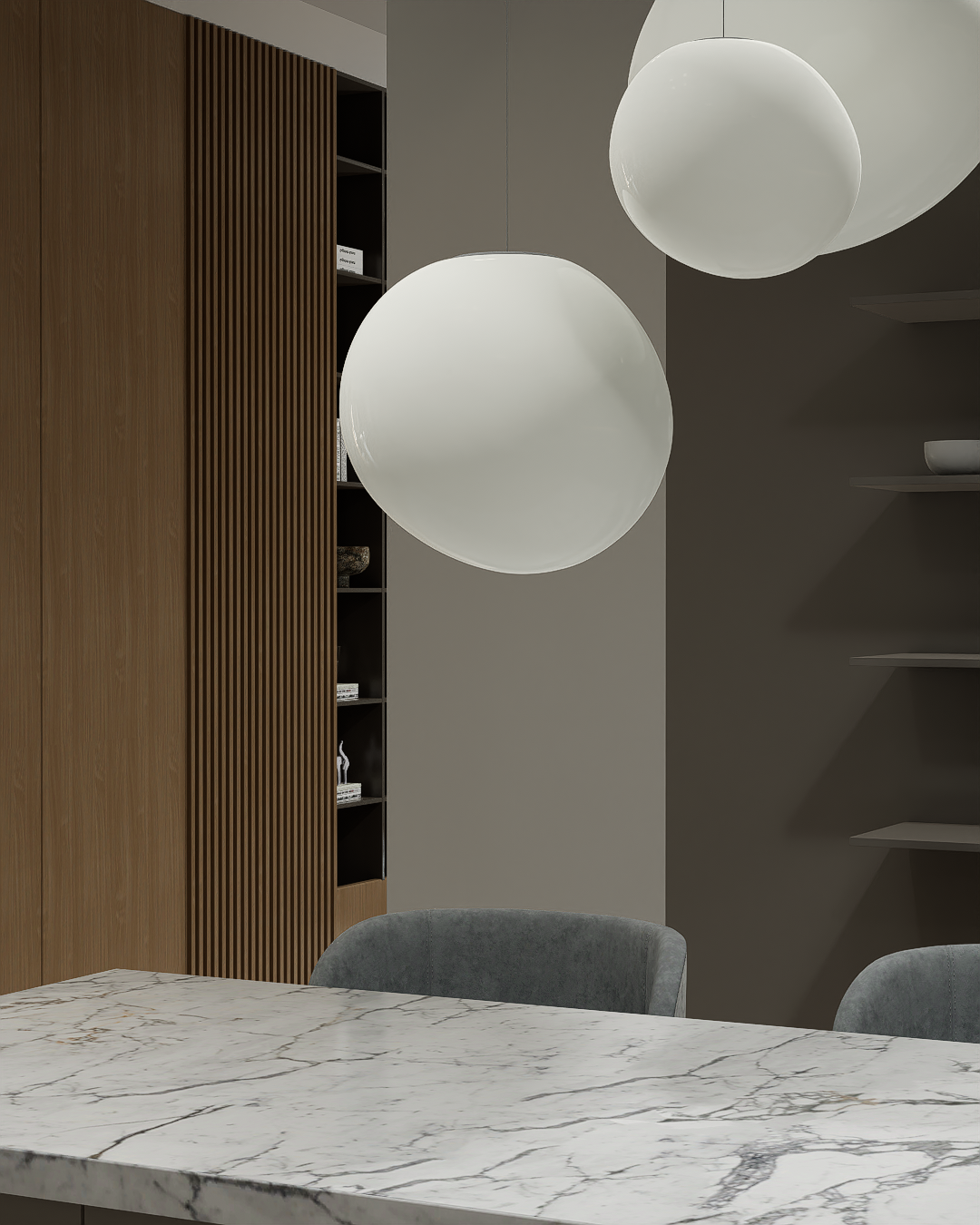
In this view, the vertical wooden paneling becomes visible, introducing warmth and tactile contrast into the space. The wood acts as a transition between the more technical kitchen zone and the surrounding living areas, softening the overall architectural composition.
The pendant lights appear again in the foreground, reinforcing the layered lighting strategy that defines the atmosphere of the kitchen.
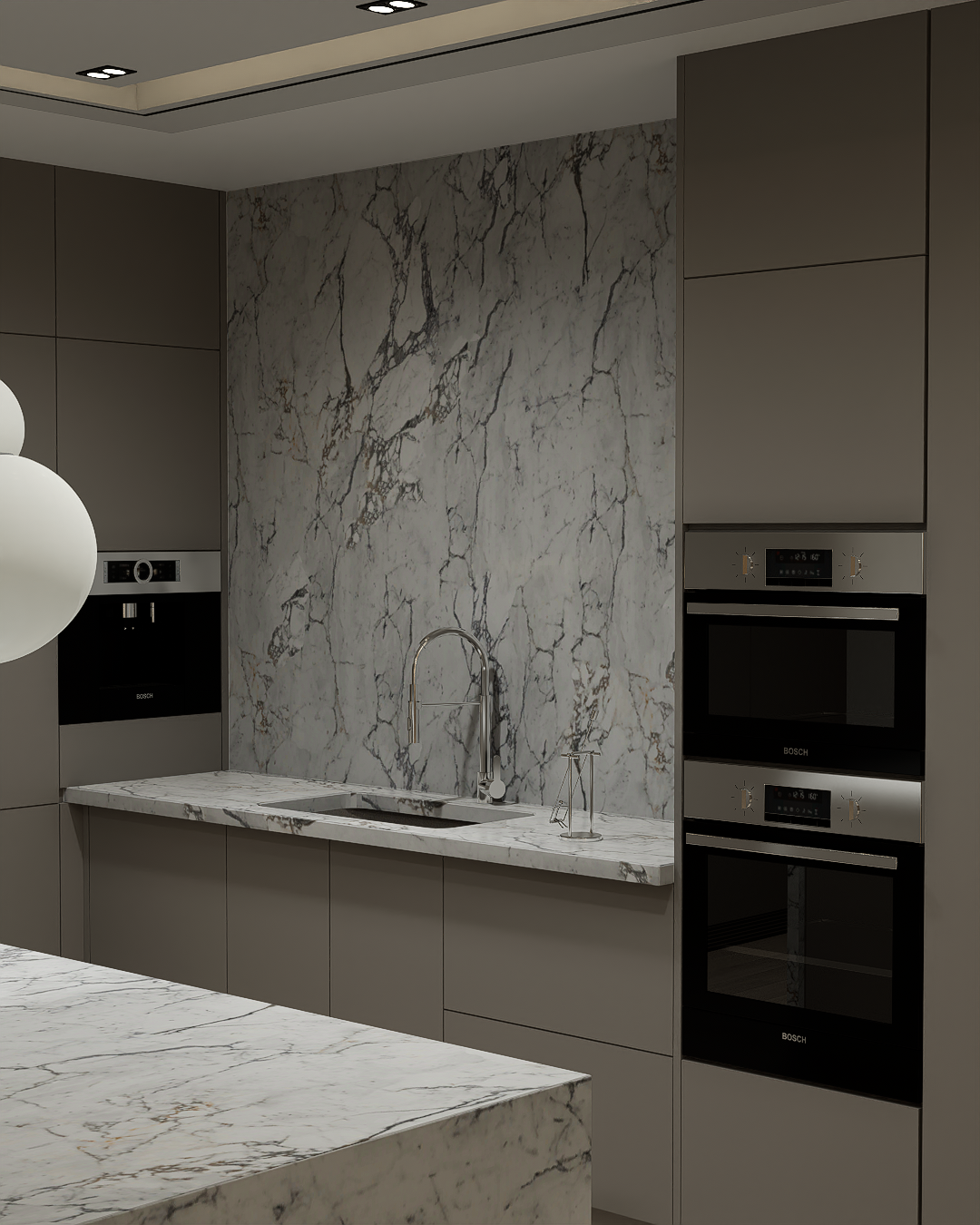
This perspective focuses on the primary working wall of the kitchen. A large marble backsplash stretches from countertop to upper cabinetry, creating a powerful visual surface that emphasizes material continuity.
Integrated ovens are seamlessly embedded within the cabinetry, ensuring that appliances remain visually subordinate to the architectural composition.
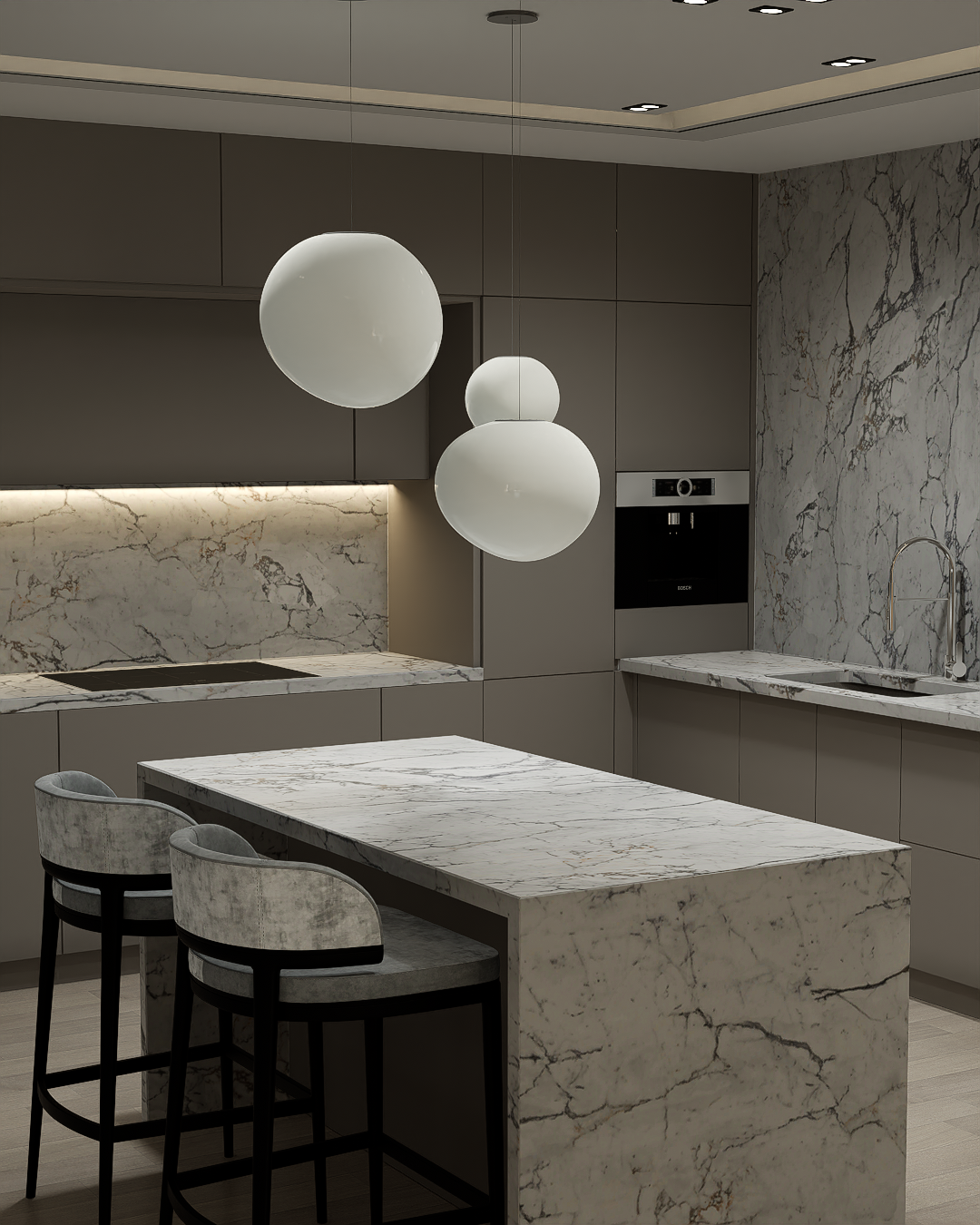
The fourth image reveals the kitchen island in its entirety. The marble volume appears almost sculptural, standing at the center of the room as a monolithic element that anchors the spatial organization.
The seating stools introduce a subtle note of contrast through darker tones and slender metal legs.
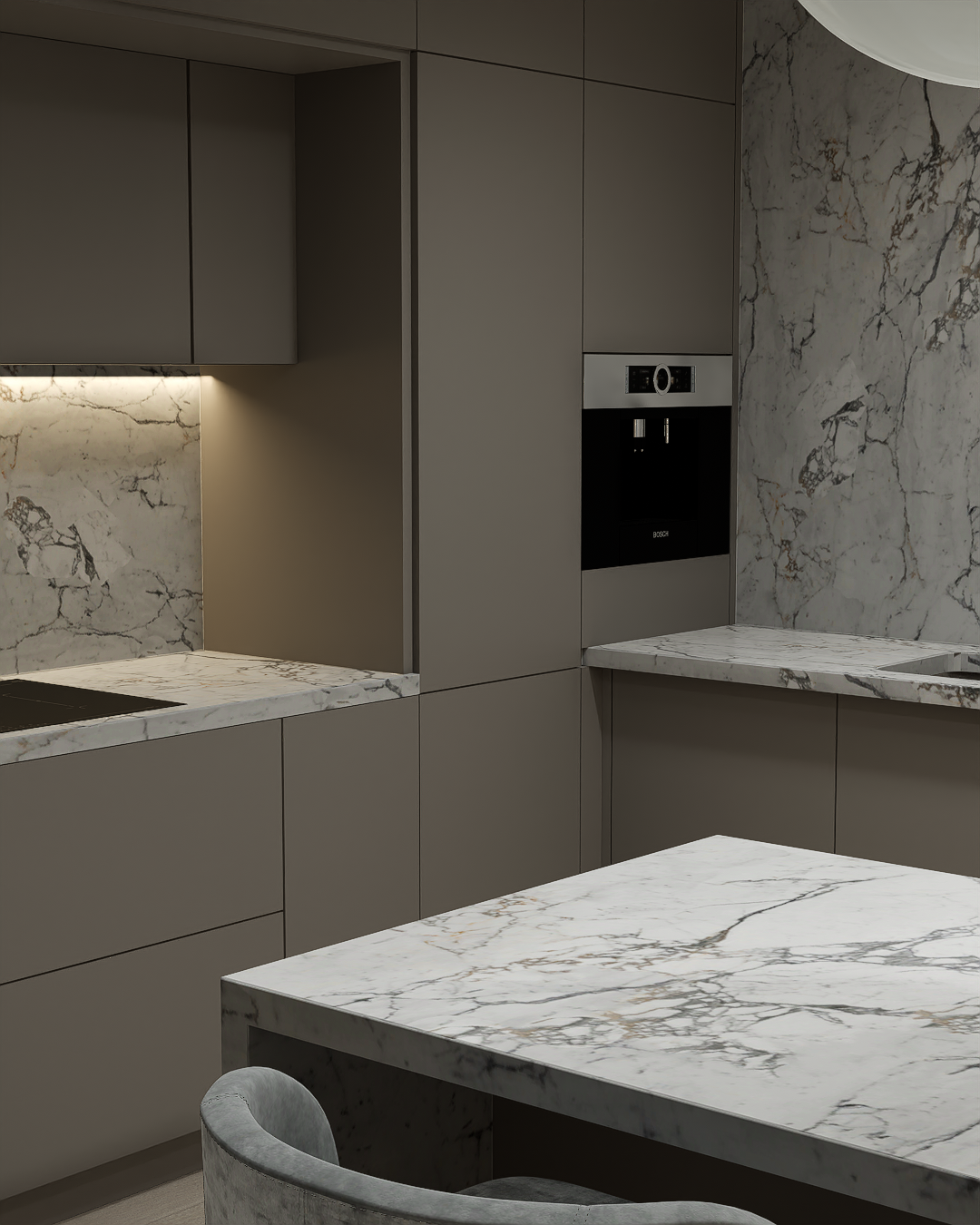
Here the viewer sees the relationship between the island and the surrounding cabinetry. The integrated lighting beneath the upper cabinets creates a soft glow across the backsplash, highlighting the texture and veining of the marble.
This lighting strategy also reinforces the functional workspace while maintaining a calm and atmospheric ambiance.
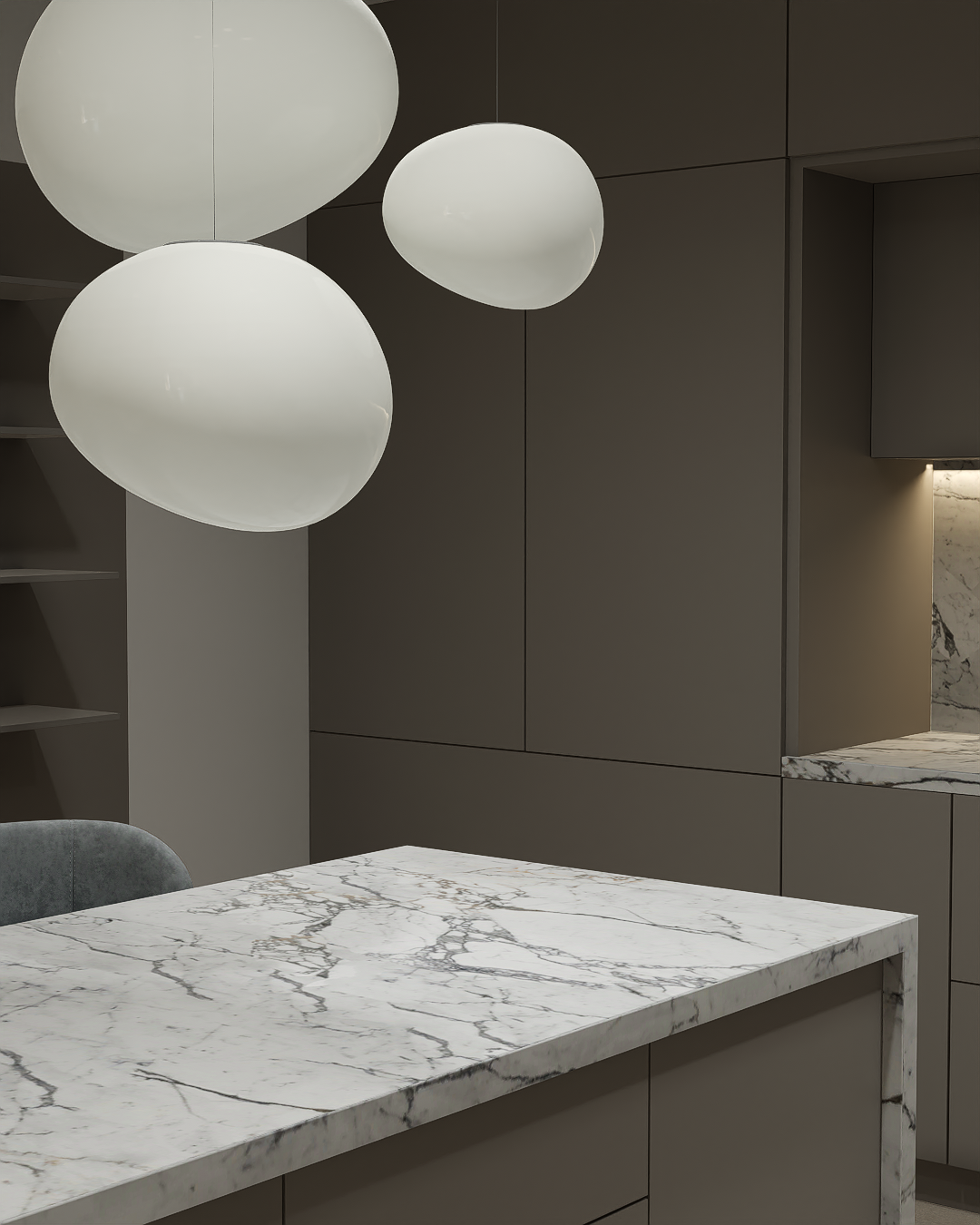
In this image, the pendant lights take on a stronger presence, hovering above the marble surfaces like luminous spheres. Their placement is carefully aligned with the geometry of the island, reinforcing the overall spatial order.
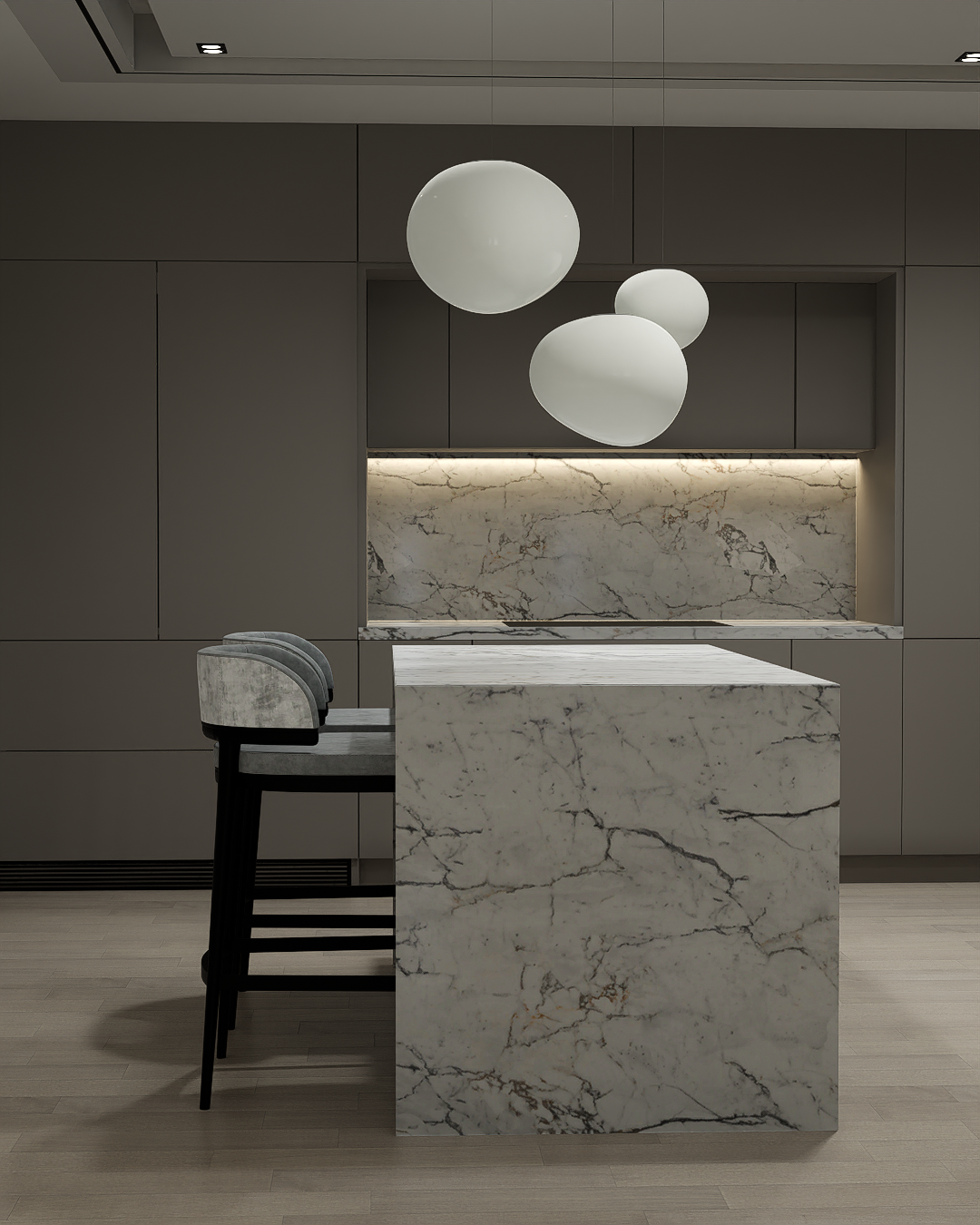
The seventh photograph captures a slightly wider view of the kitchen, revealing the precision of the cabinetry alignment and the seamless integration of storage elements.
Every vertical and horizontal line appears carefully coordinated, demonstrating the importance of proportion within minimalist design.
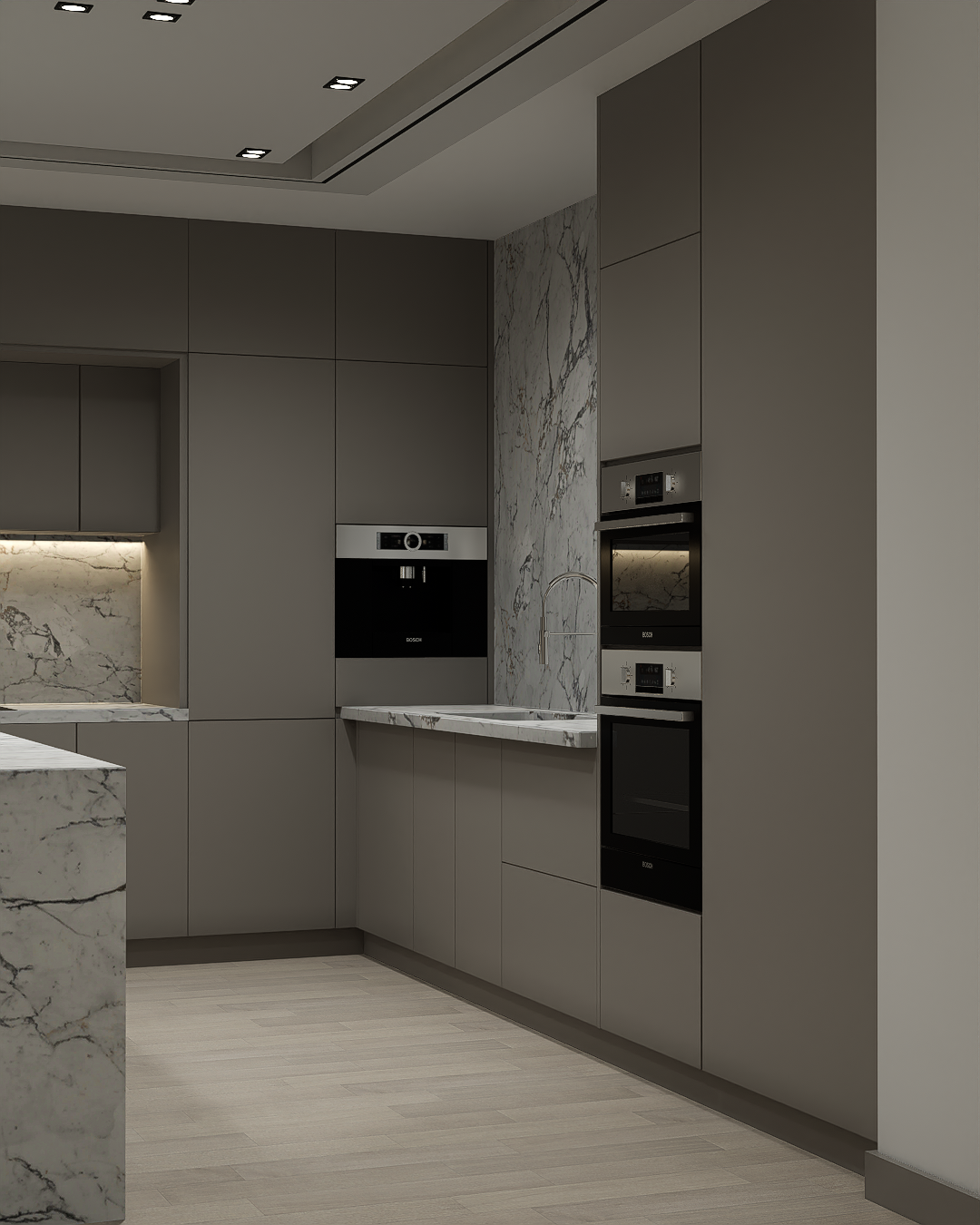
This perspective begins to reveal the relationship between the kitchen and the adjacent living room. The open layout allows visual connections across the apartment, reinforcing a sense of continuity between different functions.
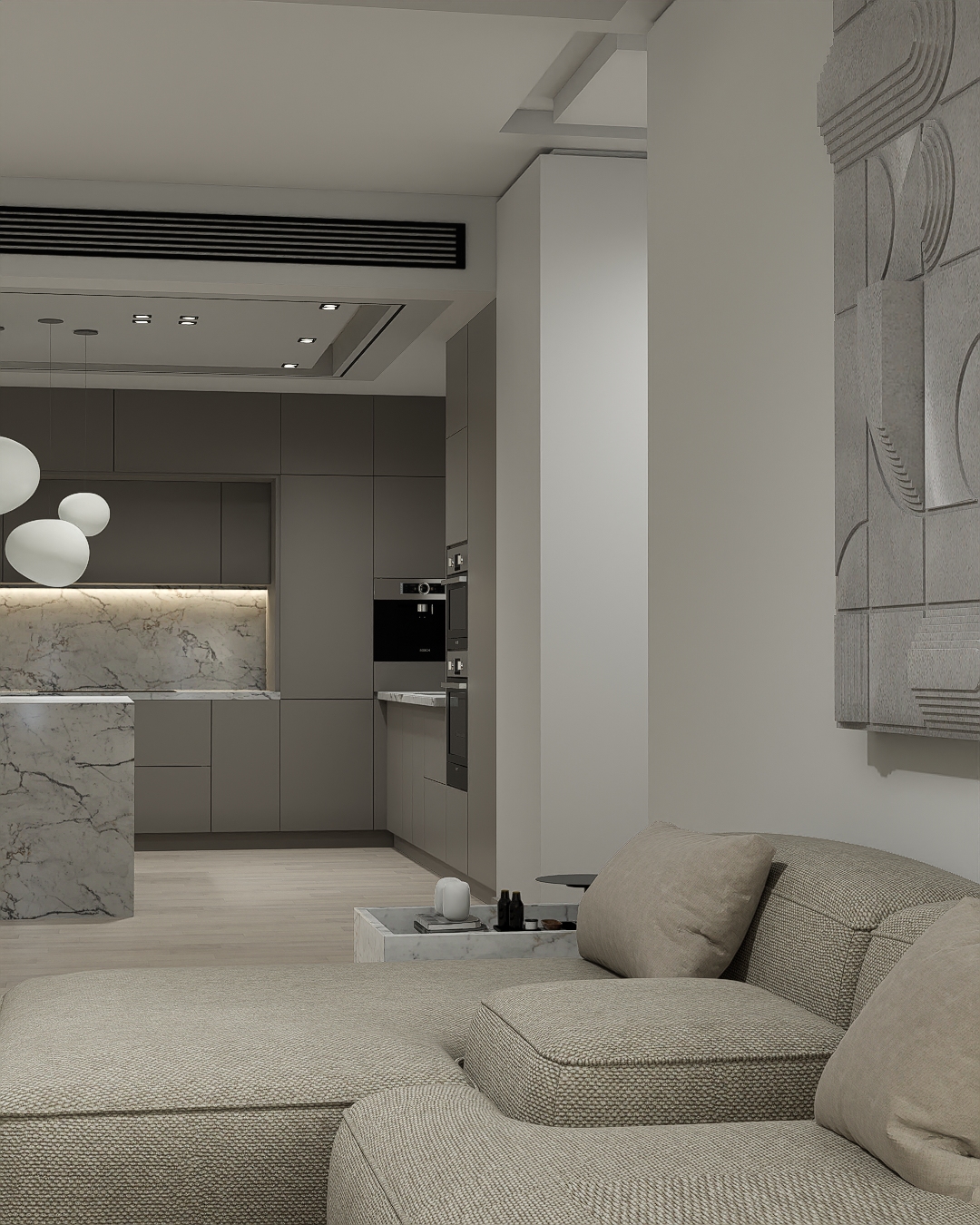
The ninth image shows the kitchen from the perspective of the living area. The marble island appears as a luminous focal point within the interior landscape, drawing attention without overwhelming the calm palette of the space.
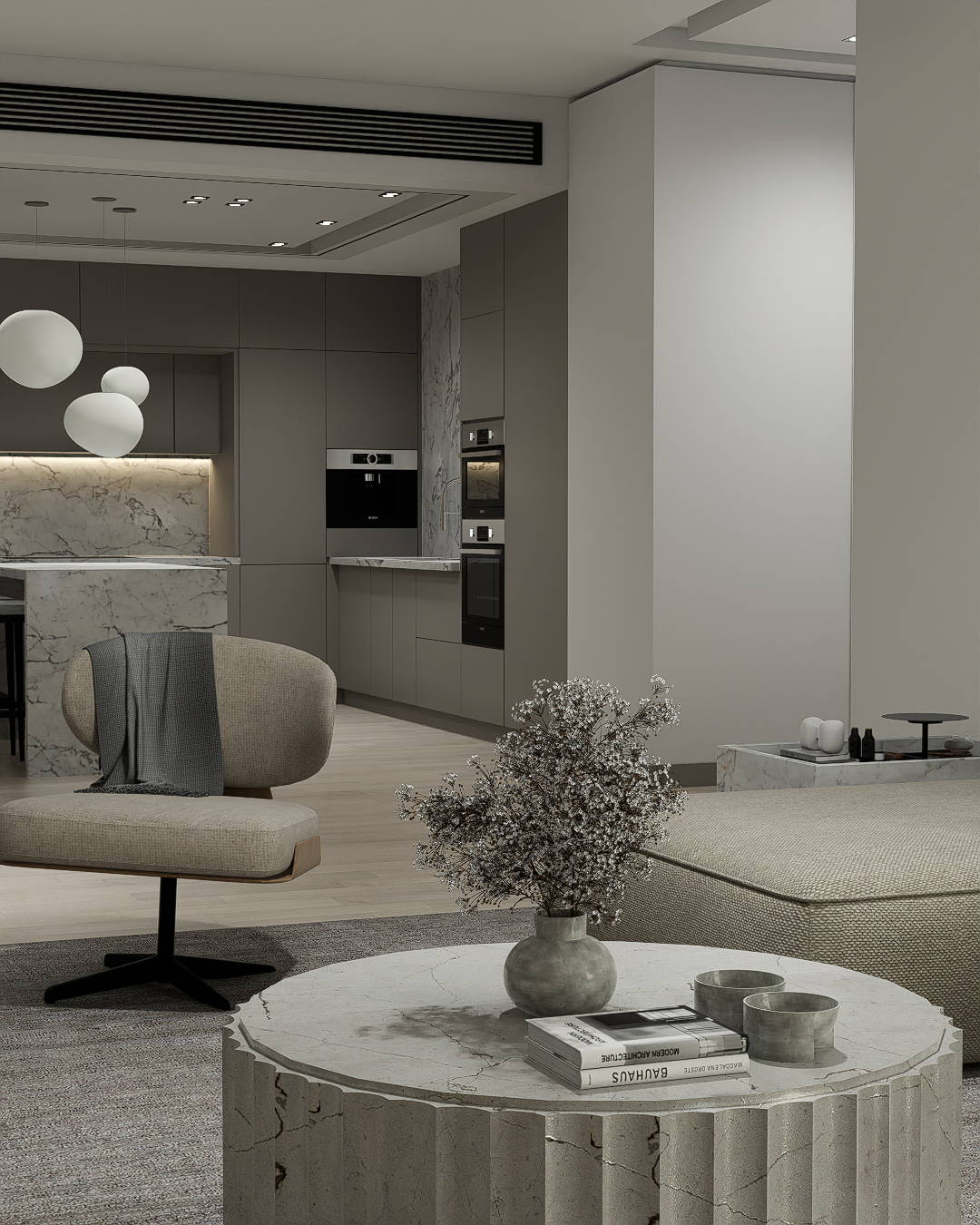
The final photograph frames the kitchen within the broader living environment. Soft furniture textures, sculptural lighting, and refined material transitions create a balanced composition where architecture, interior design, and everyday life converge.